
Full Circle: How a Chainsaw on a Climate Ride Led Me to Natural Burial
Walk through Reflection Park and you might miss the graves entirely at first. That's the point.
There are no rows of upright headstones, no manicured lawn stretching toward a horizon of granite. Instead, dappled light cascades through tulip trees, birdsong fills the air, stone markers lay flush with the earth, and wood chip trails wind through forest for visitors to wander. Somewhere beneath the moss and the root systems, bodies are doing exactly what bodies have always done before we complicated it: returning, slowly and naturally, to the soil that will support future growth. Standing in that quiet stillness, you can almost feel the cycle under your feet as the trees breathe in the new life that death has given back.
I didn't always know this is where I'd end up. Reflecting back, my personal path feels less of a choice I made and more like a thread destined for me to notice.
Where It Started: A Little Girl at the Cemetery
Most people find cemeteries eerie. For me, there was always a spiritual quality to these resting places that felt like home. As a little girl, my mom would take my younger brother and me to visit our grandmother’s grave at a sprawling cemetery, where we'd go roller skating and play ring-around-the-rosie between the headstones. These were foundational memories, strangely, lighthearted and full of joy. As an adult, I found myself wandering quaint cemeteries wherever I traveled. I couldn't explain what drew me in. It just felt natural.
The Ride That Changed Everything
In 2013, my brother Stephen and I created a 250-mile bicycle ride across Montana. This was the first DIY event for Climate Ride.
After the first few days of cycling, my body stopped resisting the physical effort and started to move based on pure muscle memory, pushing forward without needing me to ask. That's the strange gift of long-distance riding: the body goes on autopilot and the mind is freed up so that you truly experience life moving in slow motion. At twelve miles an hour, you notice things a car would blow past. So when we caught the whine of a chainsaw and the smell of fresh-cut wood drifting off the road, we stopped in a state of curiosity and intrigue.
The man behind the chainsaw was carving wood at a roadside workshop. We called him “Chainsaw Bob.” And Bob told us something that struck me, as both an environmentalist and an entrepreneur: he had converted his family's land into a natural burial ground specifically to protect it from the fracking companies buying up land across Montana at that time.
A burial ground as a conservation strategy. Land that can’t be drilled or developed because it holds the dead. The concept instantly resonated with me.
From Idea to Calling
The idea of starting a natural burial ground myself stayed with me for years — more as a playful curiosity and research endeavor — until one day, in deep meditation, I had a moment of sudden clarity and felt called to act. What happened next felt guided by something larger than me. Within a week, I attended the Green Burial Council's annual conference, where I met Basil Eldadah, now the Executive Director of Reflection Park.
At first, I thought I'd start one myself. But launching a natural burial ground is no small undertaking. So I decided to join a team already doing the work. The timing was perfect, since Reflection Park was about to open just north of DC.
Ten years after that day in Montana, I joined Reflection Park's Operations team, helping build a natural, multi-faith burial ground close to where I live. Full circle. In the years since, I've helped mold the organization’s rules and regulations, earn Green Burial Council certification, and contribute to projects like memorial stone engraving and community events — whatever the work called for. My latest project: getting Reflection Park named an official grantee of Climate Ride's fundraising, uniting the two causes that shaped my path.
Why Natural Burial Protects the Land
Natural burial protects land by design. At Reflection Park, the body returns to the earth using only biodegradable materials. Graves are marked by simple stones flush with the ground. Carbon is sequestered and natural habitat is protected. In addition, Reflection Park gives the option to reuse a grave, where, after 50 years, the family has the choice to use the grave for someone else by burying on top of the original decedent. As a result, the land continues to remain alive and protected. Land that holds the dead is land that can't easily be drilled, paved, or developed for other purposes.
Going Full Circle Again
Bob protected one piece of land by digging graves with his shovel. Today, I think about how many more acres are still waiting for someone to make that choice.
Last month, I rode Climate Ride's Green Fondo through the Berkshires of Massachusetts — my fourth Climate Ride, and one worth sharing: rolling hills, plush forests, apple cider donuts, and every mile a reminder of why this work matters. Reflection Park is now a specific beneficiary of Climate Ride’s fundraising through December 1, 2026. Every dollar raised through this effort joins the year-round charitable giving that supports Reflection Park’s operations, memorial trees, and burial assistance funds. More information about how you can advance Reflection Park’s mission through these on-going funds can be found here.
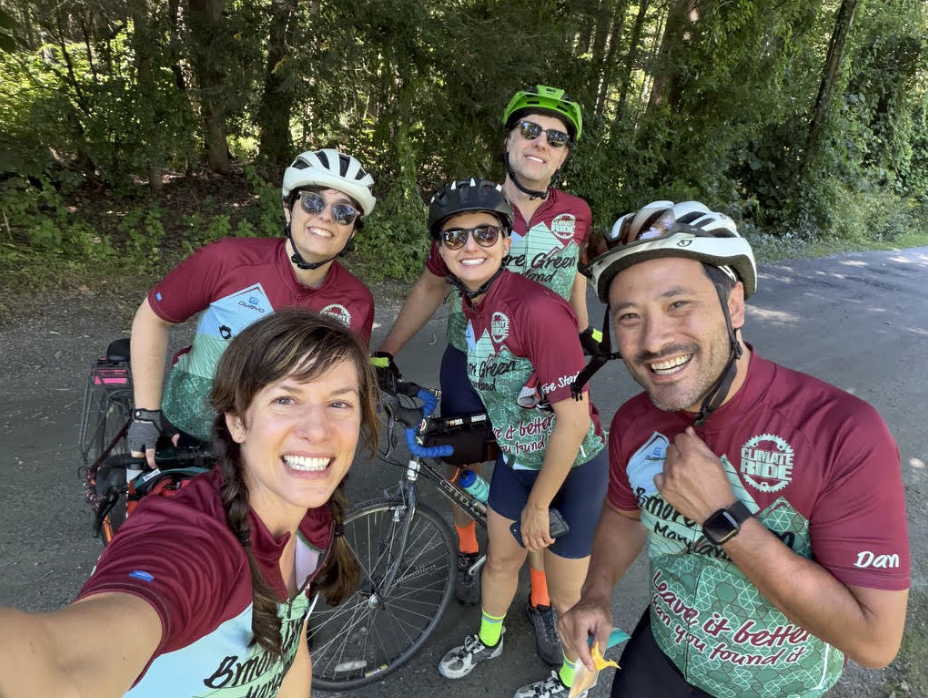
Nicole and her Climate Ride team pause for a selfie.